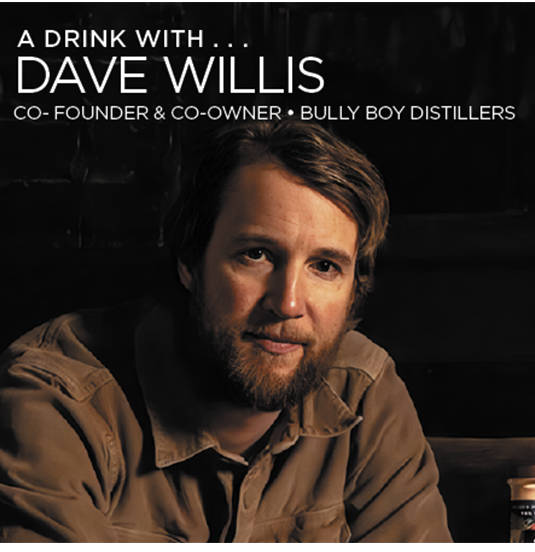
A DRINK WITH…DAVE WILLIS
By Maia Merrill Gosselin
When Bully Boy Distillers opened its doors back in 2010, it was the first craft distillery in Boston since Prohibition ended. Owned and operated by brothers Dave and Will Willis, it’s still going strong after fifteen years. Many others have come and gone in the past decade and a half, but Bully Boy has cemented itself as part of the iconic Boston craft culture scene . . . talk about setting the bar!
If you don’t know the story of how Bully Boy came to be, it reads almost like it was scripted for the Willis brothers. Dave and Will grew up on a 4th generation working farm called Charlescote, Sherborn, where the distilling bug bit them at a young age. They first made cider from farm-grown apples which led to an interest in fermenting hard cider which in turn spurred them to begin dabbling with distilling brandy and eventually whiskey. The exciting discovery of a speakeasy-style vault in the basement of the farmhouse revealed a wealth of treasures in the form of pre-Prohibition and Prohibition-era spirits their grandfather had collected. They also came across an ancient photo of a horseshoe in the vault bearing with the words: “Bully Boy. A Willing and Patient Family Instructor”. Further investigation revealed that Bully Boy was a draft horse that worked on the farm in the early 1900s. With a legacy like this, how could they not become distillers? It didn’t happen overnight of course. Both brothers would go on to separate careers (Dave as a lawyer and Will in real estate) which as Dave says, “I think we both felt were placeholders until we could get Bully Boy off the ground.”
Today, they continue to build the brand, gradually expanding both their portfolio and their footprint all while staying true to their craft identity and values. Dave is the Head of Whiskey Production and Will is the Head of Sales and Operations.Their award-winning collection includes not just a range of spirits but also bottled and canned cocktails, and most recently, a release of spirit-free RTDs. They are farm-to-glass and still use Charlescote Farm corn for their whiskey production. I checked in with Dave recently for an update on what the busy brothers and the business have been up to. There’s a lot happening and more in store for 2026. Slow and steady, they stay the course, much like their namesake!
MAIA GOSSELIN Bully Boy is Boston’s original craft distiller . . . how has the company evolved through the years from a couple of selections to your vast portfolio of today?
DAVE WILLIS We’ve always viewed flexibility as one of our competitive advantages. Because of our size, we have the ability to pursue categories we find interesting, as well as categories that are on-trend. We released our first bottled cocktail, an Old Fashioned, in 2014. We knew it was a great product, and we recognized that RTDs were a growing trend. The Old Fashioned’s success led to other offerings in the space. The same could be said for Amaro: We loved the category, we knew we could create something great, and Amaro was exploding in popularity. As with the Old Fashioned, the success of our first Amaro led to others. Fifteen years in we are still constantly looking for categories that marry passion and opportunity, most recently with our canned cocktails and spirit-free offerings.
MG The craft distilling industry is certainly seeing some challenges these days. What is your take on the current state of things, both in Massachusetts and nationally? Do you think 2026 will be an improvement or will obstacles abound?
DW The challenges will continue, but the picture is more complicated than “people are drinking less.” The larger issue is oversupply: Too many distilleries, too much inventory, all of it built on the idea that Covid drinking habits would persist, which was absurd. The brewery and distillery shakeout will continue in 2026. In fact, I think it will unfortunately get worse. At the end of 2026, there will be far fewer distilleries and breweries around.
MG You’ve stood the test of time for the past 15 years while many others haven’t fared as well. To what do you attribute your ongoing growth and success?
DW The best decision we made was not getting overextended. We never put ourselves in a position where we could get really hurt if things didn’t pan out. During the boom-times (2010-2020) it was hard to watch distilleries lever up, lay down an insane amount of inventory, and get bought for boatloads of money, but the downside risk of that approach is bankruptcy. We also never overcommitted to any one category. Again, that approach was out of favor for many years, when it paid to have a singular focus, but if all we made was Bourbon we’d be in trouble right now.
MG RTDs were one of the few areas of growth for 2025. How has the Bully Boy line of premade bottled cocktails been doing and how many offerings are in the portfolio?
DW Our bottled Old Fashioned has grown every year since it was released in 2014, which is pretty remarkable. Our other RTDs (Negroni, Manhattan) have also done well. If I could point to one market trend in the alcohol space supportive of RTDs it would be what I describe as a “return to fun.” With the rise of cocktail culture, and the rise of craft, everyone became a connoisseur, which as someone who loves and appreciates spirits was thrilling to watch. But the pendulum swung too far, and now you are seeing consumers crave something simple, crushable, and fun, which I get. RTDs scratch that itch.
MG American Single Malt has finally become a recognized category. What are your thoughts on this and are you planning on doing an ASM release?
DW I think it’s great to see. American producers of single malt bring a different perspective than traditional producers. They’re more adventuresome. It’s a unique angle that offers the consumers something new. That said, we have no plans to lay down new whiskies until there is more clarity on supply and demand.
MG Talk about some of the spirit-specific events you do . . . dinners, tastings, tours, classes?
DW Experiential tourism is a big part of what we do. Folks that come to our on-site cocktail bar love to see how the liquid is made before it goes into the cocktail they are drinking. It’s a really unique experience, and it’s one that’s been critical to building our brand.
MG It’s always a challenge to be hands-on owner-operators. How have you navigated the work-life balance and how do you stay fresh and inspired?
DW When we started Bully Boy, neither of us had kids. Now we both have three. The distillery is open seven days a week, so it could become all-consuming if we didn’t have layers in place to protect us from all the little challenges. We have great people in place to provide a layer of insulation. Maintaining a passion for the business isn’t hard though. There is always a goal to chase, whether it’s geographic expansion, product development, or product roll out . . . no two days are the same. That’s the spice that keeps us motivated.
MG What trends in the spirit world do you forecast for 2026?
DW Cans, low abv, and a combination of the two. On the flavor side it’s hard to think of something that hasn’t been done (I don’t think the world needs another hard lemonade). But I will say, a lot of the flavored products I’ve tasted in the last year have been over-flavored. They taste like jolly ranchers. So maybe it’s less about new flavors and more about executing existing flavors well.
MG You’re jumping into the spirit-free side of the business! The No/Low “trend” has become a bona fide lifestyle, not to mention it’s now a billion-dollar-a-year industry. What drove the decisions to offer a spirit-free cocktail line? How do you plan to promote this new line?
DW No one really knows how to define non-alc, and because of that non-alc is a really big tent. We were starting to see the tent get filled with products that were untethered to the alc space . . . they weren’t really an alc substitute; they were just trying to take advantage of a trend. We felt like No/Low should be made by producers who understand the space; who understand how to make a compelling, interesting alc substitute. The first two products we are bringing to market are both Amaro-centric. The first is called Alpine Highball. It’s designed to mimic a long-drink made with a botanical-forward Amaro. Our second, Sunset Spritz, is designed to mimic a citrus-forward spritz cocktail. They are both designed to be consumed on their own or as the base for a low-alc cocktail, which we call Super Session cocktails (one or two ABV). Most importantly, they are designed to help consumers looking to cut back on their alcohol consumption have fun. You are not going to see anything about “adaptogens,” “mood enhancers,” or other trendy things.
MG It’s the end of the day and you’re pouring out your happy hour libation . . . what’s in your glass?
DW I’m a creature of habit: If it’s winter, it’s an Old Fashioned. If it’s summer, it’s a Negroni.