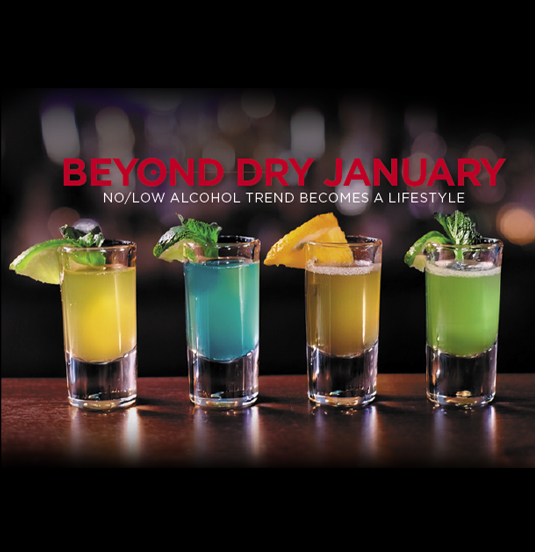
BEYOND DRY JANUARY
NO/LOW ALCOHOL TREND BECOMES A LIFESTYLE
By Maia Merrill Gosselin
The holiday crunch is over and the new year is dawning. Traditionally, January is the down month for alcohol sales as people make resolutions (however briefly) and attempt to live healthier in addition to saving money. But the past few years have seen a significant shift in this short-lived phase of teetotaling. For a variety of reasons, the “no/low” alcohol category has gone from a trend to a lifestyle. Non-alcoholic options, from carefully curated mocktails to craft NA beers and wines have taken a prominent place on beverage lists in bars and restaurants, as well as increasing shelf space in retail. According to Nielson IQ, the category, which includes non-alcoholic RTDs, mixers, wine, and beers, is approaching $1 billion in annual sales. Of course, this all begs the question: will the NA movement remain a part of our culture or will it be short lived? And how deeply should the on- and off-premise be embracing it? We spoke with a range of beverage professionals for their expert insights.
HERE TO STAY OR A FLASH IN THE PAN?
There have been plenty of alcohol trends over the years that have come and gone…Zima, hard iced teas, even White Claw mania and Fireball frenzy have settled down (though the last two remain popular today). Lauren Clark, longtime industry professional and co-owner of The Tip Top Wine Shop in Easthampton, says, “The no/low alcohol trend does appear here to stay. We stock a variety of NA wines, beers, mocktails and ‘adult’ sodas, which tend to have quality ingredients and less sugar than standard soda-pop. We taste pretty much every beverage before it hits our shelves, including NA drinks, and we only stock what we think is of high quality. There is steady interest in these items—with an uptick during dry January. We don’t sell quite as many as we did before an entire store devoted to NA drinks (Dry Humor) opened in town. Since we are focused on wine, we are happy to have Dry Humor as a competitor in the NA side of things.”
DRIVING FACTORS
Health conscious, money worries, THC products…there is no shortage of factors contributing to global reduced alcohol consumption. But which of these is the strongest driver? Hospitality consultant and BarNoirBoston founder Kyisha Davenport comments, “There’s a mix of all of these elements at play, but honestly? The millennials and Gen Xers who’ve been holding it down in business casual at the club are tired, chile. We’ve tried most of the things when it comes to drinking. Now, we’re shifting toward a more balanced lifestyle as we become more aware of this next phase of life. Or it could just be me projecting — my 35th is a week away, after all.”
From the retail perspective, Lauren observes, “All of the above except money concerns; some NA drinks are as, if not more, expensive than the alcoholic beverages we sell. In terms of THC products: We legally sold hemp-derived THC seltzers for a hot minute until the state of Massachusetts disallowed it. THC beverages are in legal limbo now, as you are aware. Easthampton’s biggest cannabis dispensary is a few doors down from us. It can be hard to tell what effect legal cannabis has on our business. We get some dispensary customers in our shop buying wine and beer. But it does seem to us that a fair percentage of younger generations, maybe 21 to 40-ish, are eschewing alcohol and social drinking for other substances and activities.”
Sailor Guevara is a spirits educator, brand consultant, and noted industry expert. She says, “There is a lot of evidence that Millennials and Gen Z prioritize experiences and quality. That’s a complete 360 from Gen X, for example, where low price, quantity and drinking out of a paper bag was sufficient for us. So, it’s taken a long time (an entire generation) for the industry to recognize the differences in how the younger generations want to consume alcohol and beverages. I think they prioritize wellness — physical, mental and emotional. We should relate the desire, and I would say the need for non-alcoholic options, to be on par with alcoholic beverages, to meet the greater need for wellness as a priority.”
BEYOND PINK LEMONADE
There’s certainly money to be made by catering to the non-drinkers in the off-premise. Limiting your selections to lemonade, root beer, and Shirley Temples is missing out on a significant source of revenue. Many customers abstaining for whatever the reason, are looking for something NA that’s still got an “adult” vibe. As Lauren Clark observes, “Any fine dining restaurant and cocktail bar worth their salt these days has bespoke mocktails as part of their menu.”
Sailor says, “I don’t think we need to reinvent the bar to make this work for everyone, just have a good selection of NA options on hand along with the alcoholic options. Bars with successful cocktail programs know how to make this work. If I create an X cocktail, can I make an easy variation removing the alcohol that will be the same flavor, different but similar? That’s what I am most impressed with, a nice selection of interesting, tasty NA cocktails, a few beers in different styles and a few NA wine options. When it looks like there was intention and a focus on quality in the NA menu, I am impressed. Also, please stop putting the NA menu at the back of the book, or as a footnote; that’s so insulting and sends the message that those cocktails are indeed a footnote. Put them front and center or incorporate them by theme or flavor.” She adds: “I also want to address pricing. If guests complain about the price of a well-made, high-quality cocktail, they will complain whether it has or does not have alcohol in it. Charge what you need to charge to stay in business, curate a good selection and craft quality drinks, just like you do for your selection of alcoholic drinks.”
Kyisha, who is well-known for her carefully curated cocktails, says, “I’ve been calling mocktails ‘free spirited’ for some time now. A healthy selection of free-spirited drinks in my programs is the norm. BarNoir sees libations as the center of advocacy work, so there’s this added layer of ‘freedom’ within the free spirited category. I firmly believe that if you are naturally, or at least genuinely, creative within the bar space, coming up with interesting, delicious nonalcoholic drinks should be a welcome challenge.”
However, what works in the on-premise doesn’t necessarily translate into retail success, especially for alcohol-free spirits. John Hafferty, proprietor of Bin Ends in Braintree and Needham, comments: “Many drinks professionals in the hospitality side of the business have done a very nice job of developing and implementing low/non-alcoholic drinks (typically in-house crafted) into their beverage program. When done right, these are legitimate options. At retail, things become quite a bit more challenging. Over the last several years, bartenders have had the opportunity to learn about and work with NA products. The typical consumer is almost always going to be disappointed when purchasing an NA expression of whiskey or gin. They expect it to have the same taste, texture, finish, etc. as the real deal. Those products are meant to be utilized in an NA version of a cocktail to provide the aromatic and flavor notes of an actual spirit in a cocktail. It takes some patience and skill to get it right.”
Kyisha also predicts NA spirits won’t have staying power, stating, “I see the nonalcoholic spirits portion of the market leveling off. I personally have not felt the pull to really incorporate NA bottles into my programs; part of that is cost, part of it being my interest in working with raw ingredients to make cocktails instead. I do see more bars stepping up their free spirited cocktail game. I’d also love to see NA beers venture into more sours, stouts or fruited territory with their offerings. Choosing not to consume alcohol, but still patronizing bars feels akin to a vegan making food that emulates what they used to eat; no, you don’t want the stuff that you’ve determined is not good for you anymore, but you still want the flavors and other elements that excite you about food. To that end, at a bar you’re still looking to enjoy tasting and consuming interesting drinks. You still want to – and should – be a part of the conversation.”
MAKE MINE A MINI
Of course, it’s not all about total abstinence. It is called “no/low” for a reason. Some consumers are choosing mindfulness and just drinking less. Hence the “tiny cocktail” trend where bars offer diminutive versions of classic cocktails, less volume and less alcohol. Customers still enjoy a nice libation, just not a super-sized version. Kyisha says, “I think this varies somewhat culturally, and among different demographics, but is definitely gaining traction in cocktail bars. My girl Marlene Olarra at Nativo in L.A. calls tiny cocktails “chiquis” (this is the best one). In Boston, we’ve been on the DTO (daiquiri time out) wave. Guests are changing their habits but still want to engage their senses when they’re dining out; a small pour or taste of that cocktail without overdoing it hits the mark. I’m here for it, but also terrified to look at my Trimark invoice once post cutesy glass shopping clarity kicks in.”
NA RTDS STILL HAVE BUZZ
The word of the year in the drinks industry could easily be “RTD” as it is perhaps the hottest category currently for pre-made cocktails. To match this with NA interests, companies have been coming out with versions of RTDs modeled after cocktails but without spirits added such as zero-proof mojitos and margaritas. Sailor Guevara is a fan of the concept, saying, “I believe everyone should make canned RTDs. Why weren’t we doing this already? If my friends are coming to the BBQ with canned beer, spritzes and cocktails, I should have the same NA option, but it better taste good!”
However, as with many concepts, brands often jump on a bandwagon and begin to saturate the market leading to product fatigue. John Hafferty surmises, “NA RTDs will, in my honest opinion, likely be a fad… hot for a year or two then gone, like spiked root beer. I predict that the very best – St. Agrestis Phony Negroni — will last and be around for the long haul, but there are a lot more products out there now that look to have been developed and pushed to market quickly to take advantage of a fad.”
BEER & WINE UP THEIR NA GAME
The beer industry was really the first to develop NA alternatives. Non-alcoholic beer has long been a standard staple at any bar or restaurant. But Athletic Brewing really changed the game up when it hit the market in 2017. In just a few short years, it has vaulted onto the Brewers Association’s Top 50 Craft Brewing Companies list, landing at #8 in 2024. Placement in not just retail stores but also grocery stores such as Whole Foods has added to its visibility and also its healthier lifestyle stance. For its part, Molson Coors has been investing heavily in the NA market, not only with its beers such as Blue Moon NA, Peroni 0.0 and Coors Edge, but also with its investments in Fever Tree non-alcoholic mixers and sodas along with Naked Life’s line of NA pre-made cocktails. A few years ago, they actually changed their name from Molson Coors Brewing Company to Molson Coors Beverage Company, a clear signal of the direction they were moving in.
While wine faces more challenges in the NA category, it’s important to remember that there are many wines with naturally low ABVs such as Prosecco, Cava, Vinho Verde, Muscadet, Moscato, Riesling, and others. Creating a section in the store or on a menu and highlighting this (with relevant alcohol and calorie information) will catch consumers’ attention. And more and more wineries are releasing zero-proof wines to cater to interest. Ninety Plus Cellars wine company offers both a zero-proof brut “Prosecco” and a sparkling rosé to complement their standard selections with alcohol.
With so many big alcohol companies doing alcohol-free line expansions, smaller brands may balk at the expense of adding on zero-proof products. Sailor comments, “I research this data regularly because I work with alcohol brands, and the fear mongering is real. Many alcohol brands are terrified of the NA space, and they shouldn’t be. Inclusivity brings everyone to the table to have shared experiences. I think the larger brands have taken up enough space and enough of our time telling us what we should drink and shoving subpar spirits down our throats, pun intended. We need a fresh perspective, and I would say that the innovators, the scrappy and agile creators, distillers, vintners, and brewers in the craft space are the people who could make this change happen. They are in the end responsible for the current popularity and education regarding spirits.”
FINDING THE BALANCE
As with all trends, things can sometimes skew too far. Do we really need NA bars with zero alcohol served? That is a trend that will probably fizzle. It’s all about finding a balance. Bin Ends’ John Hafferty says, “I believe that it is important to recognize that alcoholic beverages have been a part of our society going back at least to the times when ‘drinking the water’ could kill you. Properly understood and managed as a normal part of one’s lifestyle, beer, wine, spirits, etc. have played an important role in many cultures. By focusing our energy on maintaining a level of respect, along with moderation, I believe that alcoholic beverages can make a positive contribution to our day-to-day lives.” And that’s certainly something we can all raise a glass to!