A Q&A WITH . . . LEW BRYSON
AMERICAN SINGLE MALT TURNS ONE
WAS ITS FIRST YEAR A BOON OR A BUST?
By Maia Merrill Gosselin
For novices and connoisseurs alike, the phrase “single malt” has long held cachet when it comes to whisk(e)y whether Scottish, Irish, or Japanese. But until recently, there was no such category for whiskies produced in America, although not for a lack of trying. After much lobbying by both American distillers and the Distilled Spirits Council of the U.S., the US Alcohol and Tobacco Tax and Trade Bureau finally approved the classification on December 18th, 2024 with regulations coming into effect in January of 2025. I caught up with one of the industry’s top whisky authorities for his insights on what the last year has brought and what the future holds for the new American Single Malt (ASM) category.
MAIA GOSSELIN After years of lobbying by American distillers, American single malt whiskey was approved as a category in December of 2024, with the regulations coming into effect on January 19th of 2025. In the year since the classification has been in place, how has the category fared?
LEW BRYSON There has been no shortage or slowdown in the number of new offerings. The category got a big shot in the legitimacy arm from the arrival of Beam’s Clermont Steep, a 5-year-old American single malt from the bourbon behemoth. But there are headwinds. First, ASM seems unsure as to what it wants to be: bourbony malt aged in new uncharred barrels, or Scotchy malt aged in used barrels, a mix of the two . . . And to be clear, this is not at all a bad thing! Variety not only makes the category appealing to the ‘I want new bottles” drinker/purchaser, but it maps out more quickly what the category can be. Innovation drives discovery. But people aren’t sure what ASM is yet, and that causes some hesitation and potential disappointment. Which leads to the second issue: education is needed. Right when small distillers are tightening their belts because of macro trends – lower alcohol sales, slumping on-premise business, increased costs and tariff impacts – they should be spending money on education and promotion of this new category, and that’s going wanting. It’s like the craft spirits trend all over: there is a dedicated core of enthusiasts who are extremely knowledgeable, and a large mass of people who are vaguely excited, but not 100% clear on what it is they’re excited about. To get them to the first bottle, and to buy a second bottle after that, they need to know what’s going on here.
MG For years, distilleries would self-classify with no true accountability as to authenticity. How will this be regulated now?
LB Great question, especially given that acceptance of the new category definitions are not universally beloved! With the TTB’s continued lack of proper funding, it’s not likely to get better from that angle. Distillers may have to do the touchy work of self-policing, calling out rogues as they see them. Like them or not, the regs are the regs, and are not likely to change anytime soon, given how long this took. Things move very, VERY slowly when it comes to the Standards of Identity. I would advise people to stick to names they trust, and sample, which is my usual advice.
MG What have you been most impressed with? Any states or distilleries standing out for quality?
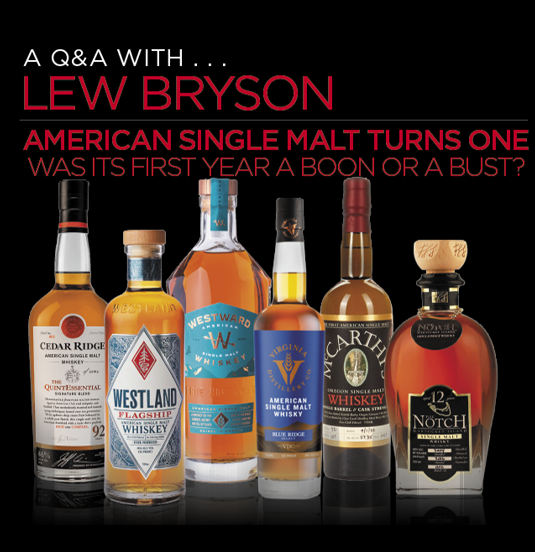
LB I’m very big on Cedar Ridge’s QuintEssential ASM right now; they have a good supply of whiskey at a good age, and it’s tasting great. Westland is bold and well-supported, and the confusingly closely-named Westward looks like it may come back from bankruptcy, which would be a rescue of some truly wonderful whiskey I was lucky enough to sample in-warehouse a few years back. Virginia Distilling has some great innovative barrel finishes on a good base whisky. McCarthy’s Oregon Single Malt finally has the backing to build on years of experience. And The Notch, on Nantucket, is way out ahead, with some of the oldest American single malt whiskey in bottles; I was lucky enough to taste some at the distillery a while back, and I’d love some more.
MG It’s no secret that the bourbon category has been experiencing its share of challenges. How do you see American single malt faring in terms of sales in both the on- and off-premise?
LB It’s all going to depend on reaching the folks in the trenches: bartenders, bar managers, and store staff. Get whiskey in their hands, tell them what you’ve got, tell them what can be done with it. Scotch single malt doesn’t have a huge cocktail library behind it like bourbon and rye do; work on creating good cocktails, and hope that one sticks. And don’t call it ‘like Scotch.’ That was the mistake I made for years and I judged the ASM category by that yardstick. It’s not Scotch. Like American wines, and like Japanese single malt, this whiskey is a new thing, its own thing, and that should not be admitted so much as celebrated. That’s the path. Can that happen? Sure, but as I’ve said before, the easy time for selling whiskey is over. It’s back to work.
MG Are consumers knowledgeable about this new niche, and are they interested?
LB Not really. They aren’t at all clear on what it is, or why they should care, which makes it hard for them to be interested. I think Westland has taken a bold and appropriate step by making ASM their identity; Cedar Ridge is taking a smart course in essentially splitting off their single malt into a sub-brand, away from their excellent bourbon, so it can stand on its own. ASM will benefit by standing apart from bourbon and rye, in my opinion, and the sooner that happens, the better. It will need its own champions. I’m pretty confident it will find them.